How to Raise Capable Kids (and Lighten Your Mental Load at the Same Time)
Mini Synopsis
Are you exhausted from being the only one who notices? In this episode, Dr. Robyn Silverman talks with therapist-turned-coach and author Sam Kelly about the Notice and Do method, a practical, research-backed system for teaching kids to see what needs to be done and actually do it, without being told, reminded, or nagged. Together, they explore the origin of the mental load, the concept of noticing goggles and learning ladders, how to start the Notice and Do method with toddlers through teenagers, the Big Three household tasks that build lifelong skills, how to adapt the method for kids with ADHD, what to do when kids push back, and why chores are not a burden but a direct pipeline to confidence, empathy, and resilience.
Introduction:
There are some things about motherhood that are exhausting in very obvious ways. The lack of sleep. The driving everywhere. The laundry that somehow multiplies while you sleep. But then there is another kind of exhaustion. The kind that comes from being the person who notices everything. The backpacks that need to be packed. The permission slip that needs to be signed. The toilet paper that is almost gone. The dishwasher that needs to be emptied. The birthday gift that needs to be bought. The kid who needs new shoes because somehow their feet grew overnight. It is not necessarily that nobody in our families is willing to help. It is that so often, mom is still the one who has to notice, remember, ask, remind, explain, follow up, and make sure it actually gets done. But what if our kids could learn to notice what needs to be done without waiting for us to point it out? And what if teaching them to do that could not only lighten the load now, but raise kids who grow into adults who understand that taking care of a home and a family is everybody’s responsibility?
Short Bio:
Sam Kelly is a therapist, feminist coach for mothers, cycle-breaker, and mom of three. She holds a master’s degree in Art Therapy Counseling and has taught at the university level. She is the creator of the viral Notice and Do® method, trusted by over 4,000 families, and the founder of the popular audio course Little Cycle-Breakers. Her work has been featured on Good Morning America, Business Insider, Upworthy, Motherly, and Scary Mommy. Her debut book, Notice and Do: Raise Capable Kids, End Motherhood Burnout, and Lighten Your Mental Load, published by HarperCollins, launched October 20, 2026. The book gives parents a clear, step-by-step framework for teaching children of all ages to proactively notice what needs to be done at home and do it, transforming them into confident, capable contributors who help break the cycle of inequitable invisible labor for future generations.
Important Messages:
Noticing Is a Learned Skill, Just Like Reading — Sam Kelly
The reason children do not notice what needs to be done is not that they are lazy or ungrateful. It is because noticing is a skill that has to be taught, just like reading, brushing teeth, or tying shoes. Most parents hand their children a list of completed tasks to execute rather than teaching them how to scan an environment, recognize a need, and act on it. Once children understand that noticing is something they can learn, everything shifts.
Step Back So They Can Step Up — Dr. Robyn Silverman
Teaching a child to grill a hamburger, do laundry, or vacuum a floor requires something that does not come naturally to most parents: stepping back after you have shown them how. The moment when a parent stops jumping in, correcting, or redoing the task is exactly the moment the child’s confidence begins to grow. It is uncomfortable. It requires tolerating imperfection. And it is one of the most important things we can do.
Chores Are Vitamins, Not Punishment — Sam Kelly
The concept of chores needs a glow-up. For too long, they have been associated with drudgery, punishment, or overloading kids who are already busy. The research says something completely different: contributing to a household is a direct pipeline to confidence, resilience, empathy, and capability. When a parent sees the full picture of what chores actually give a child, it becomes very difficult to keep doing it for them, even when it would be faster and easier to do so.
Parenting for the Long Haul — Dr. Robyn Silverman
Yes, it is faster and easier to do it yourself. Every parent knows this. But faster and easier in this moment is not the same as better for this child. When the goal is raising a capable adult who can manage a home, share a load, and function independently, the small daily inconvenience of teaching and waiting and tolerating imperfection is exactly the investment that pays off. That is parenting for the long haul.
The Mental Load Is a Whole Family Issue — Sam Kelly
The mental load, carrying the invisible weight of noticing, planning, delegating, and following up on everything that keeps a household running, is not something women made up. It is real, measurable, and well-researched. And it is not solved by getting a partner to help more, or by asking kids to do more tasks. It is solved by teaching everyone in the family what noticing means, why it matters, and how to carry it together. Whole family issues require whole family solutions.
Children With ADHD Need the Skills Most — Dr. Robyn Silverman
Both of Dr. Robyn’s children have ADHD, and they navigate it in completely different ways. What the research and her own experience confirm is that children whose executive function is already challenged need these systems even more than neurotypical children, not less. Written step-by-step instructions, visual cues, and specific scaffolding are not accommodations that lower the bar. They are tools that give a child the best possible chance to actually succeed.
Start with a Noticing Walk — Sam Kelly
The fastest and simplest way to introduce children to the Notice and Do method is a 10 to 15 minute walk through the main areas of the house, narrating exactly what you see and what signals a task needs attention. Not a lecture. Not a chore chart. A walk where you say: when the garbage reaches here, that is your signal. This is where we keep the liners. Here is how you tie it off. Making the invisible visible is the entire first step.
If They Have 15 Minutes to Scroll, They Have 15 Minutes to Contribute — Dr. Robyn Silverman
One of the most clarifying reframes in this conversation: the amount of time children spend on screens is the same amount of time the Notice and Do program requires. When the ask is framed that way, the argument that kids are too busy or too overwhelmed to contribute dissolves. It is a question of what gets prioritized, and parents have both the right and the responsibility to name that out loud.
Use Learning Ladders, Not Expectations Without Teaching — Sam Kelly
We would never hand a kindergartner a novel and get frustrated that they cannot read it. But parents do the equivalent with household tasks all the time, especially with teenagers. If a child has not been taught, they do not know, regardless of their age. Learning ladders break a skill into tiny, specific, sequential steps so children can build competence gradually, the same way they would with any other skill. Starting somewhere, anywhere on the ladder, is always better than not starting.
The Big Three: Laundry, Dishes, Bathroom — Sam Kelly
If a parent is overwhelmed by where to start, Sam recommends the Big Three: laundry, dishes, and bathroom. These are the three skills that most directly prepare children to manage their own homes one day. They are specific enough to teach in stages, broad enough to grow with a child’s age and ability, and together they form a complete, manageable daily contribution that adds up over time to a genuinely shared household.
Resistance Is Normal. It Does Not Mean It Is Not Working. — Sam Kelly
When kids whine, complain, and look for every possible excuse not to contribute, that is not a sign that the parent is doing it wrong. It is a sign that they are raising normal human children. Resistance means a parent is expanding their child’s comfort zone and asking them to grow. The right response is to normalize the stretch, go slowly if needed, start with common areas rather than a child’s bedroom, and trust that the skill is building even when it does not feel that way.
For Kids with ADHD, Add Training Wheels — Sam Kelly
ADHD changes the approach but not the destination. Strategies like body doubling, counting out loud, slap bracelets as visual cues for laundry cycles, and breaking tasks into even smaller steps are not workarounds. They are training wheels. They give a child the scaffolding to build the muscle of noticing and doing, and over time the training wheels can come off. Neurodivergent adults consistently say the same thing: they wish someone had taught them these skills as kids, because learning them as adults in the midst of managing a full life was brutal.
This Work Breaks the Cycle for the Next Generation — Sam Kelly
The deepest reason to do this work is not to get more help at home today. It is to ensure that daughters grow up knowing the mental load is not theirs by default, and that sons grow up knowing exactly what the mental load is, in a sentence, and how to be proactive about carrying it. Every family that teaches their children to notice and do is changing what those children’s future partnerships and families will look like.
Notable Quotables:
“Noticing is a learned skill. Just like reading, brushing your teeth, and tying your shoes. They can learn this. We just have to teach it.”
— Sam Kelly
“It is definitely faster and easier if I do it myself. And I have to talk myself back from that in the moment. Because a couple years from now, they are going to be on their own. And I want them to be able to do this.”
— Dr. Robyn Silverman
“Chores need to glow up. Because the research says it is a direct pipeline to confident, resilient, thoughtful, empathetic, capable kids. That is a short list of everything I want for my children.”
— Sam Kelly
“Step back so they can step up. That is the whole thing. You show them, you work alongside them, you step back, and you let them do it. Even when it is hard to watch.”
— Dr. Robyn Silverman
“The mental load is a whole family issue. And whole family issues require whole family solutions.”
— Sam Kelly
“My son has ADHD, and sometimes his hesitation is because he does not want to mess up. So I write it down. Step by step. Very specific. Because having that structure means he can actually succeed.”
— Dr. Robyn Silverman
“I just spent the last year of my life teaching an adult man how to not rely on me to see what needs to be done. So why am I perpetuating this cycle with my kids?”
— Sam Kelly
“If they have 15 to 20 minutes to scroll on their phone, they have 15 to 20 minutes to contribute and get all of these benefits and break the cycle and be more prepared for what comes next.”
— Dr. Robyn Silverman
“Don’t assume they know. Even teenagers. It is so easy to think, oh, you’re older, you should know how to do this. If they haven’t been taught, they don’t know.”
— Sam Kelly
“Pushback and resistance are so normal. If your kid whines and complains and wants to give a million excuses, congratulations. You have normal human children.”
— Sam Kelly
“I want my son to walk into a relationship knowing that the mental load isn’t something women made up. He knows what that word means. He knows how to use it in a sentence.”
— Sam Kelly
“For my daughters, I want them to know that even though our society says it is the woman’s job to carry the mental load, that is not the expectation they are going to have for themselves.”
— Sam Kelly
“Notice and Do liberated me enough to write this book. And if it can do that for me, it can do it for anyone.”
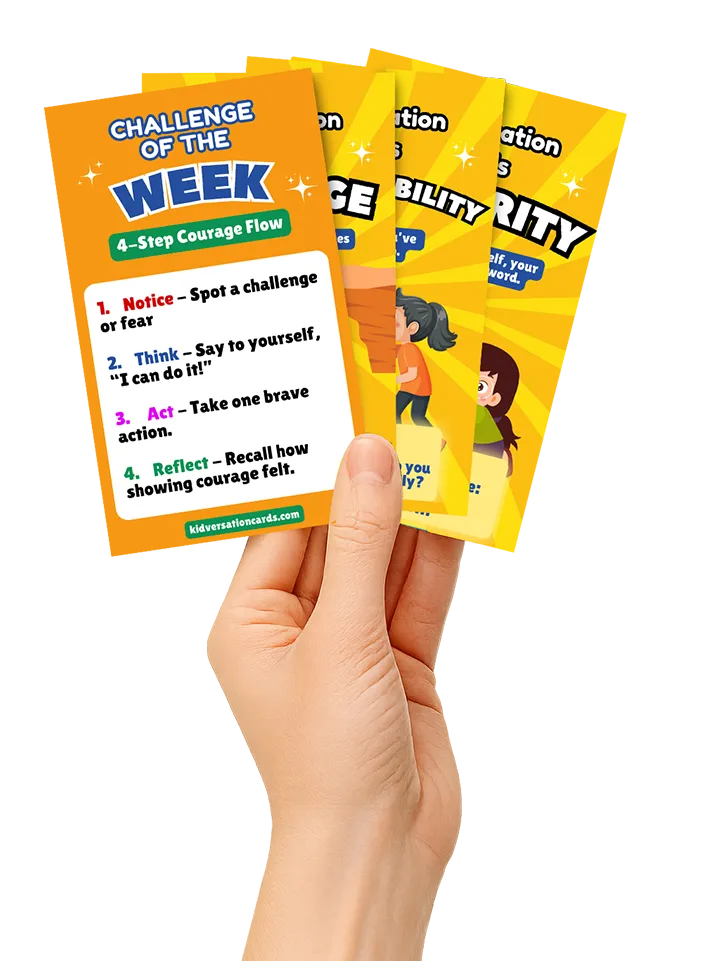
Fun prompts, zero prep, real growth. From courage and kindness to mindset and resilience, each card sparks skills that matter. And the best part? Kids love them. Build character, strengthen connection, and make every moment count—one question at a time.
What Are These Cards?
KIDVERSATION CARDS These aren’t ordinary cards. Created by Child Development Specialist and “Conversation Doc” Dr. Robyn Silverman, Kidversation Cards make meaningful conversation simple. Each one taps into the 6 Cs—Confidence, Competence, Contribution, Caring, Character, and Connection—a proven framework for helping kids thrive. Fun for kids and easy for parents, they spark quick talks that build lasting skills and memories.