Podcast: Play in new window | Download
Subscribe: Apple Podcasts | RSS | More
How to Get the Family Unstressed & Recharged in a Stressful World

Mini Synopsis
Are you stressed, burned out, or overwhelmed, and so are your kids? You are not alone, and there is no single fix that works for everyone. In this episode, Dr. Robyn Silverman welcomes back licensed mental health counselor and author Janine Halloran to talk about building a personalized coping toolkit for the whole family. Together, they explore why knowing who you are comes before choosing a strategy, how mini-connections and deeper friendships calm the nervous system, what to do with big feelings like anger, relaxation options for people who roll their eyes at deep breaths, why play is a legitimate coping tool, how sensory and movement strategies help, and why your coping skills should be a living document that changes as you do.
Introduction:
Welcome to the modern world, where if you aren’t feeling stressed and overwhelmed, you might not be paying attention. Anxiety levels are through the roof, demands fight for our attention, and distractions own our focus. And when the adults in a home are running on empty, kids feel it too. If you or your kids are feeling stressed, burned out, or overwhelmed, you are not alone. The good news is that coping is a skill, and skills can be learned, personalized, and practiced. But the deep breath that calms one person can leave another person rolling their eyes. Today’s conversation is about finding the set of coping strategies that actually fits you and your family, so you can master the hectic pace of life, stay focused, and find balance.
Short Bio:
Janine Halloran, MA, LMHC, is a Licensed Mental Health Counselor who has spent more than 20 years working with children, teens, and their families. She is the founder of Coping Skills for Kids and Encourage Play, LLC, and the host of the Calm & Connected Podcast. Her work has been featured in The Boston Globe, CNN, Huffington Post, Psych Central, and The Skimm. She is the author of the bestselling Coping Skills for Kids Workbook, the Coping Skills for Teens Workbook, and Social Skills for Kids. Her newest book, Coping Skills for Everyone: A Workbook to Get Unstressed, Recharge, and Stay Calm in a Chaotic World, was published in October 2026 and includes a foreword by Dr. Robyn Silverman. Janine is a repeat guest on How to Talk to Kids about Anything and a mom of two who lives in Massachusetts.
Important Messages:
Start by Knowing Who You Are — Janine Halloran
Before choosing a coping strategy, Janine asks people to look at their life stage, their personality, and their sensitivities. A parent in the sandwich generation, caring for teenagers and aging relatives, has a very different amount of time and energy than a parent of toddlers. An introvert may find a big party horrifying but love a one-on-one coffee date. Someone with asthma may skip running but thrive in a predictable gym class. Knowing yourself keeps you from borrowing strategies that were never built for you.
There Is No One-Size-Fits-All Strategy — Dr. Robyn Silverman
When Dr. Robyn led a breathing exercise for 4,000 mothers and daughters on Zoom, she asked them to rate their stress before and after. Some went from a seven to a six or a five, some landed in between, and some felt no change at all. The results were all over the map, which is exactly the point. A strategy that works wonders for one person may do nothing for the person next to them, and neither response means something is wrong.
Mini-Connections Count as Coping — Janine Halloran
We live in a world where we are very connected and not connected at the same time. Janine encourages small moments of human contact: holding the door, chatting about the price of eggs, giving or receiving a compliment on a sweater. These mini-connections remind us we are noticed, and they pull us out of isolation, especially for people who move between home and work without ever visiting a coffee shop, a library, or another third space.
Coping Can Be as Simple as Mindful Chocolate — Dr. Robyn Silverman
One of the first lines Dr. Robyn wrote in her foreword to Janine’s book was about mindfully eating chocolate as a coping mechanism, and it has become her go-to example when she speaks about progress over perfection. Coping strategies do not have to look clinical or complicated. They have to work for you, and they can be enjoyable.
Being With Other People Is Regulating — Janine Halloran
Connection is not just pleasant, it is physiological. Janine points to the tend-and-befriend response, where our nervous systems calm when we connect with others and help take care of them. She encourages people to keep deepening friendships and family relationships while also noticing that the small moments count. Connection looks different for everyone, whether that is a one-on-one coffee, a gym class full of familiar faces, or a phone call.
Combine Strategies Instead of Choosing Just One — Dr. Robyn Silverman
When Dr. Robyn wants to center herself, she goes for a walk, looks at the trees, and listens to a podcast. Sometimes it is a TED talk, and sometimes it is something completely off topic that lets her lose herself in a story. Pairing movement, nature, and a little distraction is a legitimate toolkit. A solution to stress does not have to be one thing at a time.
All Feelings Are Okay. It’s What You Do With Them That Matters. — Janine Halloran
A feeling is a signal, not a good or bad thing. Janine invites people to notice where a feeling shows up in the body: clenched fists, heat creeping up the neck, an urge to move. Anger in particular is a big feeling that wants to move. Organizing, taking a walk, wall push-ups, a short jog, gardening, or throwing sticks for a dog can all help that energy move through in a way that makes sense.
Distraction Works When It’s a Reset, Not Avoidance — Dr. Robyn Silverman
Distraction can be a helpful reset as long as it does not become a way to avoid the feeling. During her Zoom for mothers and daughters, Dr. Robyn showed a seven-second cat video as an example, and pet videos are her personal favorite reset because they are cute and often hilarious. The key is choosing the distraction on purpose, giving it a limit, and knowing when to come back.
If Deep Breaths Don’t Work, Try Another Door — Janine Halloran
Teens roll their eyes at “take a deep breath,” and it truly does not work for everyone. Janine offers alternatives: progressive muscle relaxation, where you squeeze and release your muscles; a body scan that focuses only on the release of tension; and playful grounding such as rainbow grounding, where you find two red things, two orange things, two yellow things, and so on. She often returns to deep breathing later, because it helps bring shoulders down from the ears, but it does not have to be the starting point.
Play Is One of the Most Overlooked Coping Strategies — Janine Halloran
Play is a natural stress reliever, and it is not just for kids. When the brain keeps circling the same worry, a puzzle, a crossword, gardening, crocheting, woodworking, writing, or a deep dive into something you love can hold your attention long enough to break the rumination. Play is a state of mind that lets you lose track of time. If your play is a phone game, put a time limit on it so a reset does not turn into a spiral or avoidance.
Use Your Senses to Calm and Center — Janine Halloran
Sensory strategies work best when they are personal. A familiar cologne, vanilla, a fresh orange, or freshly cut grass can calm through scent. A picture of the ocean, a sunset, or someone who loves you can calm through sight. A song from childhood or your teenage years can calm through sound, and often gets the body moving too. The sensory tool that works is the one tied to your own memories and preferences.
Movement Is a Regulation Tool, and It Can Be Small — Janine Halloran
Movement helps us regulate physically, mentally, and emotionally, but only if it fits you. A person who dislikes running should not be told to run. A ten-minute walk noticing the trees, a class with other people, weights in the basement, a trampoline, or a jump rope can all work. Movement can also be tiny: fidgets, stretches, and shoulder rolls. Janine reminds us why recess matters for kids, and for teenagers and adults too.
Your Coping Skills Are a Living Document — Janine Halloran
Janine thinks of coping skills as a list that keeps changing. Some strategies stay, some go, and some get added as you grow. Her top tip is to look back at what you loved as a child and ask what made you laugh recently, what brings you joy, and what you have not yet let yourself try. Some days are for deep work and some days are for 90s nonsense. Honoring that is part of the skill.
Notable Quotables:
NOTABLE QUOTABLES
“We live in this world where we’re very connected and then not connected at the same time.”
— Janine Halloran
“I call them my Zumba girls. They know things about you, and when you don’t show up, they’re like, where were you? And that feels really special.”
— Dr. Robyn Silverman
“There is something regulating about being with other people. It’s calming. It’s soothing when you can connect with people and help take care of other people.”
— Janine Halloran
“It doesn’t have to be one thing at a time. It could be a variety of things that can help us.”
— Dr. Robyn Silverman
“All feelings are okay. It’s okay to be mad. It’s okay to be sad. It’s a signal. It’s what you do with the feelings that matters.”
— Janine Halloran
“Anger is a big feeling, and it makes you want to move. Go out and garden, dig something up, throw some sticks for a dog, whatever it is to move your body in a way that helps that anger move through.”
— Janine Halloran
“I think play is one of the most overlooked coping strategies that is out there.”
— Janine Halloran
“Maybe it’s the scent of a fresh orange or fresh-cut grass. Using your sense of smell can actually be something that’s very calming.”
— Janine Halloran
“I always think of coping skills as like this living sort of document. Some strategies stay. Some strategies go. Some strategies get added over time.”
— Janine Halloran
Resources:
Janine Halloran ↓
-
Website: CopingSkillsForKids.com
-
Instagram: @janine_halloran
-
Book: Coping Skills for Everyone: A Workbook to Get Unstressed, Recharge, and Stay Calm in a Chaotic World
- Podcast: Calm & Connected Podcast
Dr. Robyn Silverman ↓
- Website: DrRobynSilverman.com
- Podcast: How to Talk to Kids about Anything
- Book: How to Talk to Kids about Anything: Tips, Scripts, Stories, and Steps to Make Even the Toughest Conversations Easier
- Instagram: @dr.robynsilverman
Facebook: Dr. Robyn J.A. Silverman
YouTube: Dr. Robyn Silverman - Bluesky: Dr. Robyn Silverman- Parenting
Turn Small Talks into Big Lessons- FAST.
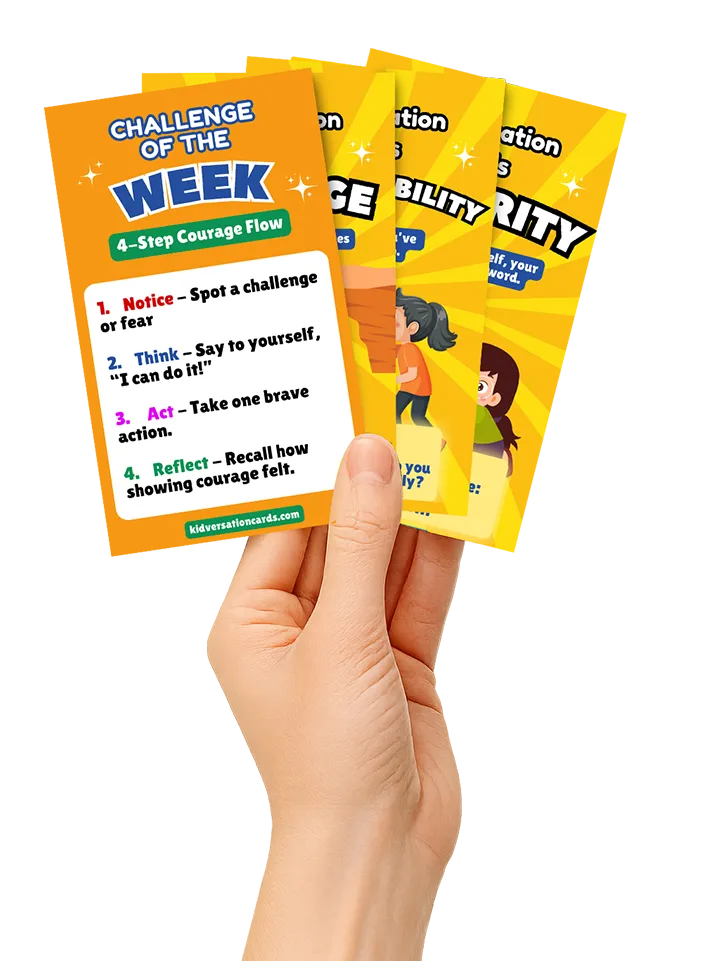
Fun prompts, zero prep, real growth. From courage and kindness to mindset and resilience, each card sparks skills that matter. And the best part? Kids love them. Build character, strengthen connection, and make every moment count—one question at a time.
What Are These Cards?
KIDVERSATION CARDS These aren’t ordinary cards. Created by Child Development Specialist and “Conversation Doc” Dr. Robyn Silverman, Kidversation Cards make meaningful conversation simple. Each one taps into the 6 Cs—Confidence, Competence, Contribution, Caring, Character, and Connection—a proven framework for helping kids thrive. Fun for kids and easy for parents, they spark quick talks that build lasting skills and memories.